Tank or Tankless Water Heater? Fit and Yearly Energy Use
Tank or tankless water heater? Enter household size, showers at once and fuel for the type that fits and its yearly energy use in kWh, therms or propane.
The results on this page come from public data and general rules of thumb, applied to what you entered. They can be wrong or out of date, and they may not fit your home. They are not professional advice, an inspection or an offer of service. Before you act on anything here, check it with a licensed pro or the agency named on the page. Any decision you make is your own, and we are not responsible for losses from relying on these results.
Data: DOE Uniform Energy Factor test and efficiency standards · ENERGY STAR water heater criteria · DOE 120°F setpoint guidance · this tool's own figures: the UEF for each type, daily hot water and tank size by household, and groundwater by winter band (42, 52 or 65°F) · Updated November 2026
How to choose between a tank and tankless water heater
Tankless flow limits and showers at once
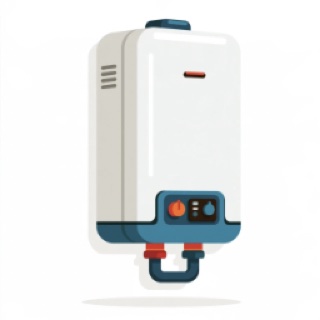
A tankless unit heats water as it flows, so it is limited by how many gallons per minute it can heat at your temperature rise. Two showers draw about 4 GPM of hot water. In this tool, one condensing gas unit covers two showers in all three winter bands.
Storage tanks and standby heat loss
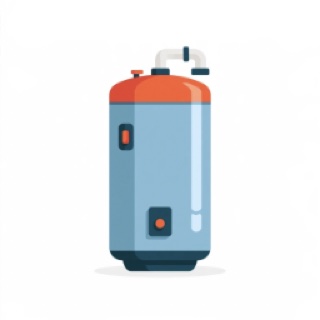
A tank can serve several showers at once from what it holds, then reheats. The trade-off is standby loss: heat leaks from the tank all day, even when no one is using hot water.
Yearly energy use from UEF ratings
Every water heater sold in the US carries a Uniform Energy Factor (UEF) rating. Yearly energy here is the hot water your household uses, heated from your groundwater to 120°F, divided by this tool's UEF for each type: about 0.64 for a gas tank, 0.95 for condensing tankless, 0.93 for an electric tank and 3.3 for a heat pump water heater.
Gas, propane or an all-electric house
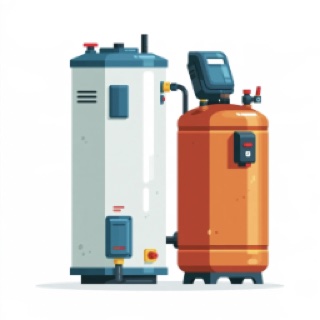
With natural gas or propane, the choice here is between gas tankless and a gas tank, with a heat pump water heater shown alongside. In an all-electric house, the tool picks a heat pump water heater, which uses the least energy where there is a place to put one.
Water heater type and energy questions
Is tankless better than a tank water heater?
It depends on your peak use and your fuel. On this tool's ratings, condensing gas tankless uses about a third less gas than a gas tank, and it keeps heating as long as the flow stays under its limit. When the peak is bigger than one unit can handle, a tank or two linked tankless units cover it.
How much energy does a water heater use in a year?
For a family of four, across this tool's three winter bands, roughly 145 to 205 therms a year for a gas tank, about 100 to 140 for condensing gas tankless, about 2,900 to 4,100 kWh for an electric tank and about 800 to 1,200 kWh for a heat pump water heater. With propane, a gas tank comes to about 160 to 225 gallons a year and condensing tankless about 105 to 150. The colder your groundwater, the higher the number.
What is a Uniform Energy Factor?
The efficiency rating on a water heater's yellow EnergyGuide label, from the Department of Energy test. A higher UEF means less energy for the same hot water, and the rating already counts a tank's standby loss.
Can an electric tankless water heater run a whole house?
For one shower at a time, yes, in all three winter bands this tool uses. For two showers at once, only where groundwater is warm. The largest units it counts are about 36 kW, which takes a very large electrical service, and an electrician confirms whether the house can carry one.
What is a heat pump water heater?
An electric tank with a heat pump on top that pulls heat from the surrounding air into the water. On this tool's ratings it uses a little over a quarter of the electricity of a standard electric tank.